Hi everyone! It’s me again — June, your IELTS Tutor. 
In today’s session, we’ll explore one of the most essential aspects of your IELTS Speaking Test — the Speaking Band Descriptors — and understand how they help you know exactly where you stand in your IELTS preparation.
 What Are IELTS Speaking Band Descriptors?
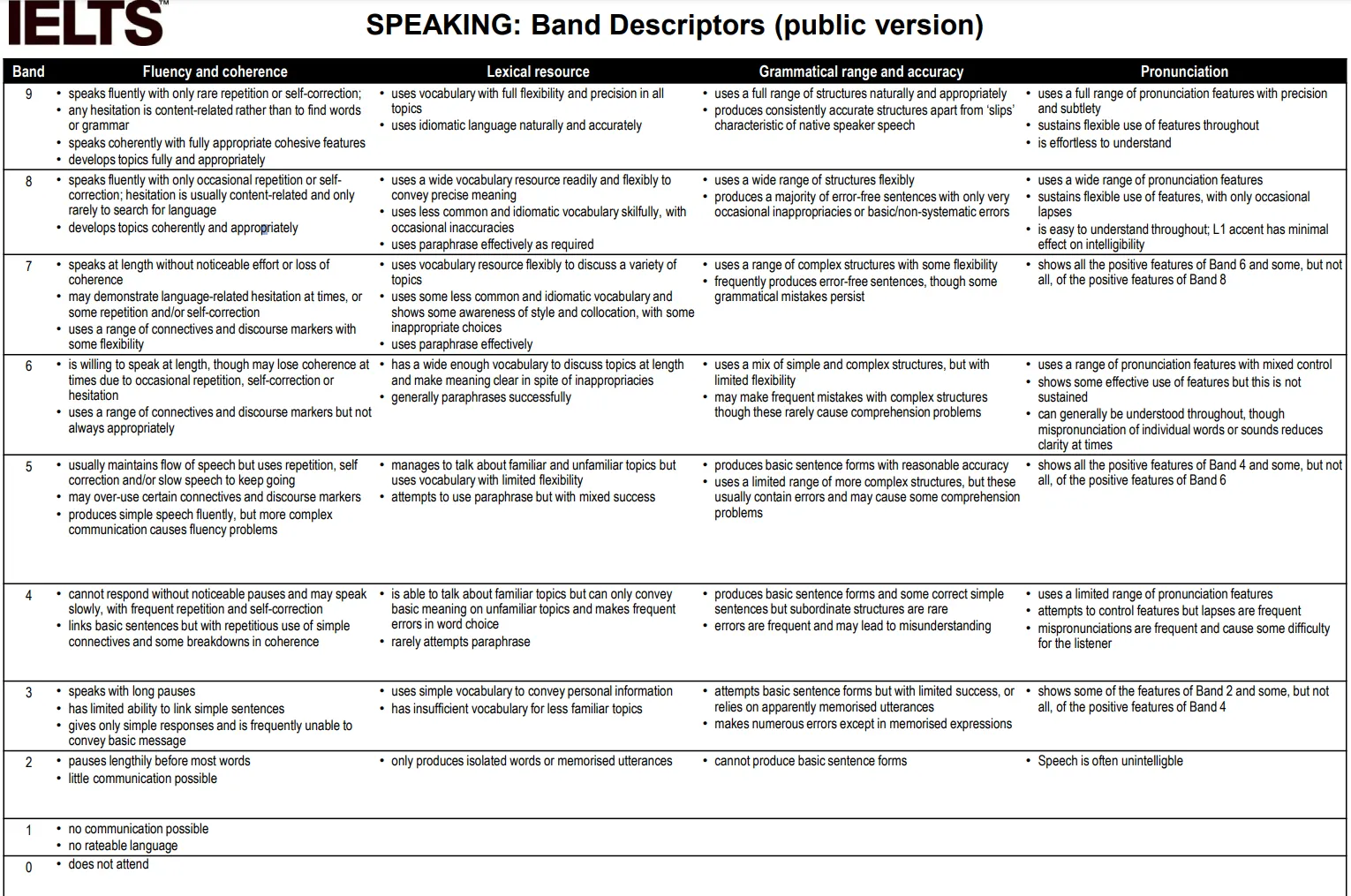
The IELTS Speaking Band Descriptors are the official criteria examiners use to evaluate your speaking performance. They explain what’s expected at each band score (0–9) based on four key areas:
1.
Fluency & Coherence
2.
Lexical Resource (Vocabulary)
3.
Grammatical Range & Accuracy
4.
Pronunciation
These descriptors serve as your roadmap to success — they show what examiners listen for and what skills you need to improve to reach your target band.
 See the detailed chart below to understand the differences across bands:
 Criterion 1: Fluency & Coherence
Fluency and Coherence measure how naturally, smoothly, and logically you can speak English.
It’s not about speaking fast — it’s about speaking clearly and confidently, organizing your ideas well, and making it easy for the listener to follow your thoughts.
 What is Fluency?
Fluency means being able to speak continuously and naturally without long pauses or hesitation. Examiners look for smooth speech flow, where you can speak for a long time without stopping to think too much. Natural rhythm and pace is also taken into account, where you don’t speak too fast or too slow. Besides, few fillers or occasional “um” or “uh” is okay, but having too many breaks and pauses significantly shows that you lack of fluency. Finally, you should keep in mind to extend answers. It means you should develop your ideas beyond one sentence.
Example:
 Fluent answer:
“I enjoy spending time outdoors, especially hiking. It helps me relax after a busy week, and I love discovering new trails with my friends.”
 Not fluent:
“I… uh… like going out… um… hiking maybe… because… it’s relaxing… yeah.”
What is Coherence?
Coherence refers to how logically and clearly you organize your ideas. Your answer should make sense and flow naturally from one idea to the next. If examiners test you in this area, they usually look for logical order of ideas, where you present your points in a clear sequence. Also, you have to use of linking words and phrases to connect ideas and provide a clear topic development, where you explain your points with examples or reasons.
Common Linking Words:
•
To add ideas: also, moreover, besides, in addition
•
To give reasons: because, since, as, due to
•
To contrast: however, on the other hand, although
•
To give examples: for example, such as, for instance
•
To conclude: overall, in general, all in all
Example:
“I prefer living in the countryside because it’s peaceful and the air is cleaner. Also, there’s less traffic compared to the city, so it’s easier to relax and focus.”
This response flows naturally — that’s good coherence.
Tips to Improve Fluency and Coherence
1. Practice speaking without scripts
Instead of memorizing answers or reading from notes, challenge yourself to talk freely about any topic for about 2 minutes. You can choose simple topics like your hobbies, favorite food, or recent experiences. The goal is to train your mind to think and speak spontaneously, just like in a real IELTS Speaking test. At first, it might feel uncomfortable, but over time, this helps you build confidence, fluency, and natural rhythm when speaking.
2. Record yourself and review your performance
Use your phone or computer to record your voice while speaking, then listen carefully afterward. Pay attention to your pauses, hesitations, or repeated words like “uh,” “you know,” or “like.” Notice if your ideas flow logically and if you speak clearly. You can also keep a notebook to track progress — write down the mistakes you notice and plan how to improve them next time. This is a powerful way to monitor your development and become more aware of your speaking habits.
3. Learn and use linking phrases naturally
Linking words make your speech sound smooth and connected. Instead of giving short or choppy answers, try using connectors like:
•
For addition: moreover, besides that, also
•
For contrast: however, on the other hand
•
For giving examples: for instance, such as
•
For cause and effect: because of this, therefore
Practice using these phrases in everyday speech until they come naturally and automatically, not memorized. This will make your responses sound more cohesive and organized.
4. Think in English instead of translating
Train your brain to form thoughts directly in English, rather than translating from your native language. Start small — describe what you’re doing, what you see, or what you feel in English as you go through your day. For example, while cooking, you might think: “I’m chopping the vegetables now.” Over time, this helps you speak faster and more naturally, since you avoid delays caused by translation.
5. Expand your answers with reasons and examples
Avoid one-sentence answers. Instead, try to explain your ideas fully by giving reasons and examples. For instance, instead of saying, “I like reading,” you could say:
“I like reading because it helps me relax and learn new things. For example, I recently read a book about space exploration that was really fascinating.”
This shows the examiner that you can develop ideas and express them clearly, which is essential for higher band scores.
6. Practice everyday conversation, not memorized answers
Real communication is about understanding and responding naturally, not reciting pre-learned scripts. Try to engage in English conversations daily — talk to friends, classmates, or even language partners online. Discuss real topics like movies, travel, or current events. This helps you adapt to different questions, use spontaneous language, and sound more genuine and confident during your test.
For my next blog, I will discuss the specific criteria from band 6 to 9 since this will go you detailed ideas what you have to do to achieve your target band score.
 What’s Next?
In my next blog, we’ll break down Band Scores 6 to 9, so you’ll know exactly what skills and performance levels are required to achieve your dream in terms fo fluency and coherence.
Stay tuned — and keep practicing with purpose!